

Registration Number: MCI/09-34751 | Last reviewed: 22nd Oct 2026
Once someone hears the words "you may need spine surgery," the next thing they hear is usually a confusing list: open, minimal access, microscopic, endoscopic. It's easy to assume the "minimally invasive" option is simply better.
The honest answer is that neither approach wins for everyone. The right one depends on your condition, your scan and your health. This guide explains the difference in plain language, so you can have a better conversation with your spine surgeon in Pune.
What is open spine surgery?
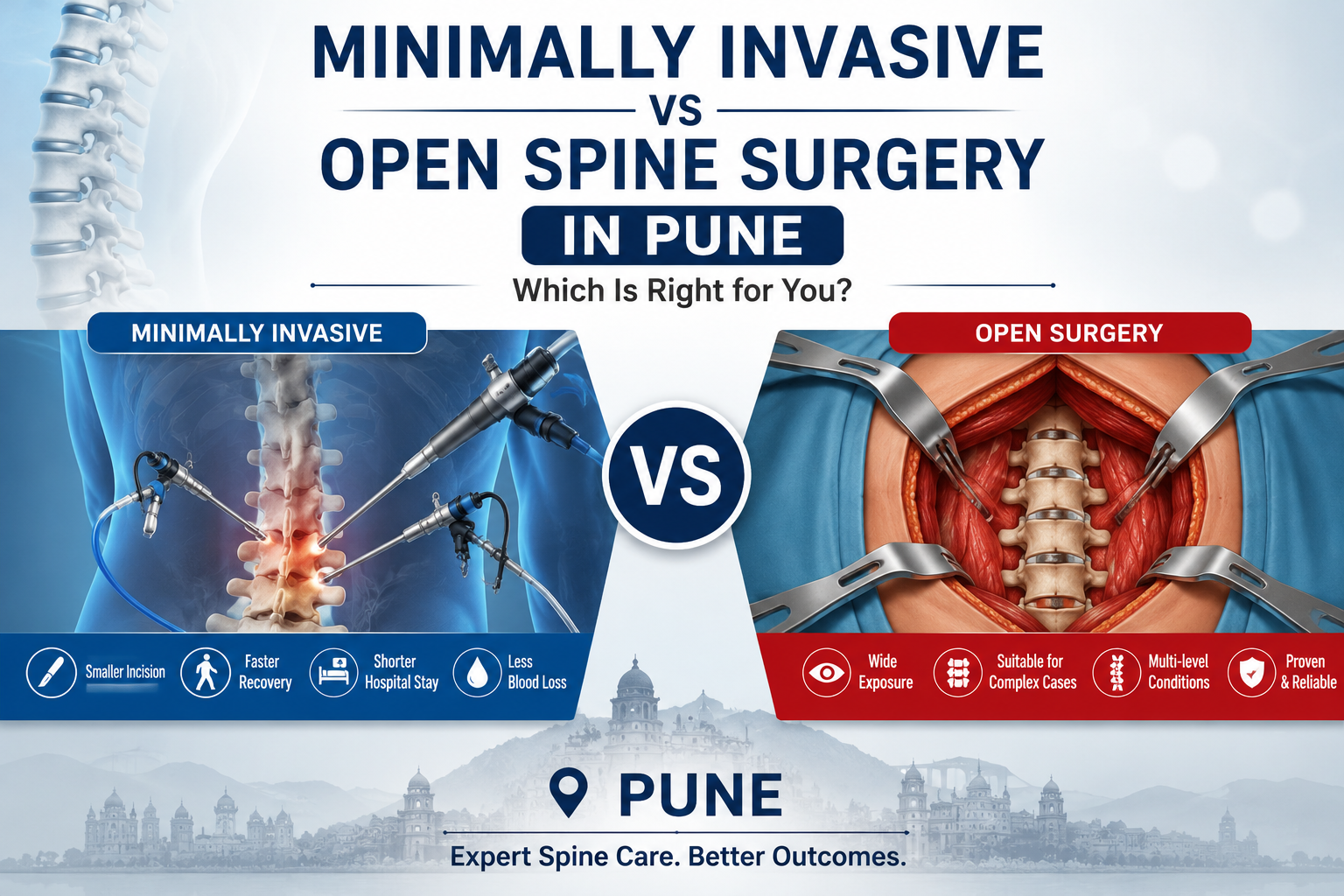
In open surgery, the surgeon makes a longer incision and moves the back muscles aside to see the spine directly. It's a time-tested method, and it's still the right choice for many problems, especially when the surgeon needs a wide view or has to work at several levels.
What is minimally invasive spine surgery?
Here the surgeon works through a smaller incision, using thin tubes or an endoscope along with a surgical microscope. The idea is to disturb less muscle while still reaching the same problem. At Orthos Centre, minimally invasive procedures are supported by a surgical microscope, spine navigation and intraoperative neuromonitoring, which helps the team watch nerve function during surgery.
Side by side
| Open surgery | Minimally invasive | |
|---|---|---|
| Incision | Longer | Smaller |
| Muscle disturbance | More | Usually less |
| Blood loss | Usually more | Usually less |
| Hospital stay | Often longer | Often shorter |
| Best suited to | Complex, multi-level or deformity cases | Selected disc, nerve and stenosis problems |
| Limitation | More tissue disturbance | Not suitable for every condition |
Who may be a candidate for minimally invasive surgery?
Commonly, it's considered for a slipped disc pressing on a nerve, certain cases of lumbar spinal stenosis, and selected cases of instability. Your surgeon decides after examining you and reviewing your MRI.
When open surgery is the better choice
Open surgery is often preferred for significant spinal deformity such as severe scoliosis, spine tumours, extensive infections, complex fractures, revision surgeries, and problems involving many levels. Choosing open surgery in these cases isn't old-fashioned. It's what's safest.
What about recovery?
After many minimally invasive procedures, patients walk within a day and go home sooner. Open and fusion surgeries generally need a longer stay and more careful recovery. But recovery depends on your age, general health, the exact procedure and how well rehabilitation goes. Your surgeon will give you a personalised timeline.
Risks: be wary of anyone who says "none"
Every surgery carries risks, including infection, bleeding, nerve injury, a tear in the covering of the nerves, and the chance that symptoms return or need further treatment. Minimally invasive surgery isn't risk-free, and it takes experience to do well. Ask how often your surgeon performs the exact procedure being recommended. We list more questions like this in 10 questions to ask your spine surgeon.
What does spine surgery cost in Pune?
There's no honest single number. Cost depends on the procedure, the levels involved, implants if needed, length of stay and room category. Rather than quote a figure that may not fit you, we prefer to give an estimate after examining you and reviewing your scans. Our team can also help you understand what your insurance may cover.
Do you need surgery at all?
Often, no, at least not first. Most back and leg pain is treated with medication, physiotherapy and lifestyle changes. Surgery is usually discussed when these fail, or when there's progressive weakness or serious nerve compression. If you're unsure, bring your scans for a second opinion.
Want to know if you're a candidate? Book a consultation with Dr. Shrikant Dalal, spine surgeon at Pune.
Book a ConsultationFrequently asked questions
Is minimally invasive spine surgery painless?
No. Pain is often less than with open surgery, but it isn't absent.
Is minimally invasive surgery safer?
Not automatically. Safer means the right operation, done well, for the right patient.
Can every slipped disc be treated this way?
No. Suitability depends on the disc, the nerve compression and your overall condition.
Will I need a scan before deciding?
Usually yes. See when an MRI is needed.
