

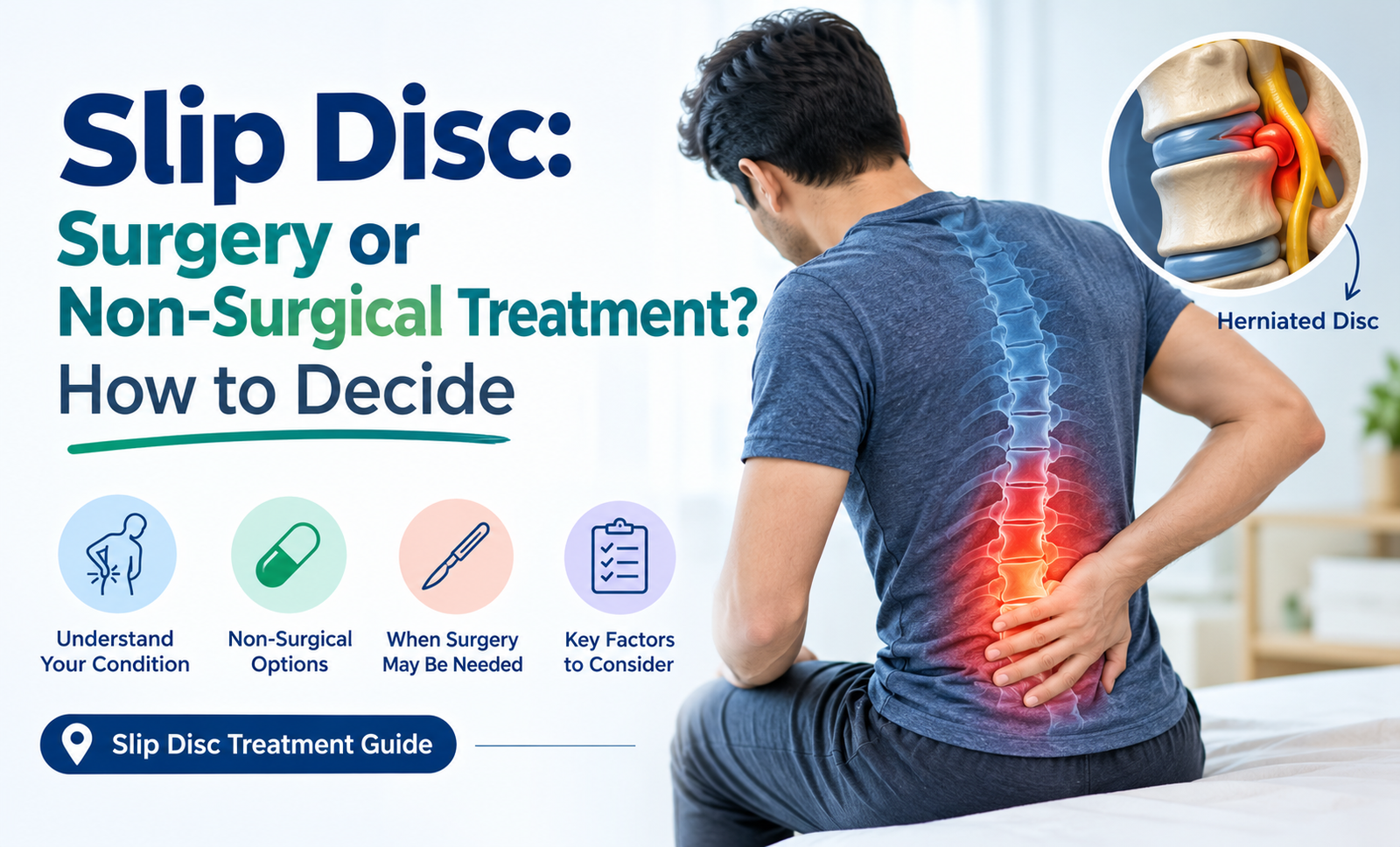
Slip Disc: Surgery or Non-Surgical Treatment? How to Decide
Key takeaways
- Not every slip disc needs an operation. Many people improve with structured non-surgical care.
- Surgery usually gives faster relief of leg pain for patients who qualify, but non-surgical patients also improve and keep improving.
- Surgeons commonly wait roughly two to three months before advising surgery, unless weakness is getting worse.
- Bladder or bowel changes, numbness around the groin, or fast-worsening leg weakness are emergencies.
- Keyhole (microdiscectomy-type) surgery is a safe option for the right patient, but it carries small risks, including the disc herniating again.
If you have been told you have a slip disc, the first question on your mind is probably the same one patients ask in our Baner clinic every week: will I need surgery? The honest answer is, it depends. Some people recover fully with physiotherapy and time. Others have nerve pain that does not settle, and they get their life back only after a small operation. This guide explains how that decision is made, what research shows, and how you can prepare for the conversation with your spine surgeon.
What Is a Slip Disc and Why Does It Cause Leg Pain?
Each disc in your spine has a tough outer ring and a soft inner core. A disc does not really slip. In a herniated disc, part of the inner core pushes through a weak area of the outer ring and irritates or squeezes a nearby nerve. In the lower back this usually shows up as pain travelling down the leg, often more troublesome than the back pain itself.
Lumbar disc herniations are most often seen between the ages of 20 and 50, and the large majority occur at the two lowest levels, L4-L5 and L5-S1.
Does Every Slip Disc Need Surgery?
No. In a large US study that followed patients with confirmed disc herniation, those who stayed on non-surgical treatment improved significantly, and that improvement lasted over the four years of follow-up. A spine surgeon writing for the National Spine Health Foundation makes the same point: the evidence shows that many patients improve without an operation, and surgery is reserved for those who fail proper conservative treatment.
That is why a good spine specialist starts by asking whether surgery is needed at all, rather than which operation to do.
Non-Surgical Treatment: What It Includes
Non-surgical care is not just taking painkillers and waiting. A structured plan usually combines several parts:
- Medicines to reduce nerve inflammation and pain, taken as prescribed by your doctor
- Physiotherapy and guided exercise, including spine rehabilitation and manual therapy
- Posture and ergonomic correction for desk work, driving and two-wheeler commutes. See our posture training programme.
- Image-guided injections (epidural or nerve-root) for selected patients with persistent nerve pain
- Short period of relative rest, then gentle activity. Prolonged bed rest is not recommended.
Your part matters as much as the treatment. Reducing body weight, quitting smoking, keeping blood sugar under control if you are diabetic, and building core strength all improve the chance of avoiding surgery.
How long should you try? Surgeons commonly allow roughly two to three months of proper non-surgical treatment before recommending surgery, but earlier if weakness is progressing. The patients in the SPORT study had leg symptoms for at least six weeks before they were even considered for surgery.
When Is Surgery Recommended for a Slip Disc?
| Your situation | What we usually advise | Urgency |
|---|---|---|
| Leg pain easing week by week | Continue non-surgical care | No surgery needed |
| Severe leg pain, no improvement after several weeks to about three months of proper treatment, and MRI matches the symptoms | Discuss keyhole discectomy or similar surgery | Planned |
| Progressive weakness in the ankle, foot, toes, hamstring, quadriceps or hip flexor | Early surgical evaluation | Sooner, do not wait |
| Bladder or bowel changes, numbness around the groin, fast-worsening leg weakness (possible cauda equina syndrome) | Emergency hospital care and surgery | Same day |
| Large disc on MRI but little pain or weakness | Usually non-surgical care. We treat the patient, not the scan. | No rush |
What Does the Research Say? A Plain-Language Summary
The most cited study on this question is the Spine Patient Outcomes Research Trial (SPORT). It enrolled 1,244 patients at 13 spine clinics in 11 US states. All had imaging-confirmed lumbar disc herniation with leg symptoms lasting at least six weeks. Researchers compared standard open discectomy with usual non-surgical care. Here is what the four-year results showed:
- The strict randomised comparison showed no major difference. This happened because many patients did not stay in the group they were assigned to. Several chose surgery after trying non-surgical care, and others in the surgery group delayed or declined it.
- When patients were compared by the treatment they actually received, the surgery group improved more in pain, physical function, disability, sciatica symptoms, satisfaction and self-rated progress.
- The benefit of surgery appeared early, from about six weeks, peaked around six months and lasted through four years.
- Non-surgical patients also improved a lot and stayed improved. Return to work was similar in both groups by year four.
There is a caution. Patients who chose surgery tended to have worse pain and function to begin with, so the comparison is not perfectly even. The study authors adjusted for this but acknowledge the limitation. The practical lesson is balanced: surgery tends to bring faster and, on average, greater relief for people with persistent nerve pain who are good candidates, while non-surgical care is a sound choice when symptoms are bearable and improving.
| Factor | Non-surgical treatment | Surgery (keyhole / micro discectomy) |
|---|---|---|
| Speed of relief | Gradual, often over weeks to months | Usually faster relief of leg pain |
| Longer-term result | Many improve well and stay improved | On average a somewhat greater gain in pain and function in suitable candidates |
| Main risks | Medicine side effects, symptoms may persist | Small risk of infection, nerve or dural injury, residual pain, disc herniating again |
| Recovery | Continue life with rehab and posture work | Short stay, physiotherapy within weeks, desk work often within a few weeks |
| Return to work after four years | Similar | Similar |
| Best suited for | Improving symptoms, no weakness | Persistent severe nerve pain, progressive weakness, emergencies |
Surgical Options for a Slip Disc
If surgery is needed, the aim is simple: remove the piece of disc pressing on the nerve while disturbing as little healthy tissue as possible. Options include:
- Keyhole discectomy: done through a small incision with a microscope or a narrow tube, so soft tissue disruption is minimal and recovery is quicker
- Endoscopic spine surgery: a thin camera allows very selective decompression in suitable cases
- Minimally invasive spine surgery: smaller incisions, usually less blood loss and a shorter stay
- Artificial disc replacement: for carefully selected patients only
Many patients leave the hospital on the same day or after a short stay, and physiotherapy typically begins within two to three weeks to help the muscles and nerve recover. Which option suits you depends on your MRI, your symptoms and your general health. At Orthos Centre, Dr. Shrikant Dalal uses surgical microscopes, spine navigation and intraoperative neuromonitoring for precision and safety. Read about robotic spine surgery in Pune too.
Risks and Limits of Slip Disc Surgery
An honest discussion includes the downsides:
- The disc can herniate again. In SPORT, about one in ten surgical patients needed another operation within four years, and roughly half of those were for a recurrence at the same level.
- Other complications are uncommon but real. The most frequent in SPORT was a small tear in the covering of the nerves (dural tear). Others include wound infection, scar tissue and residual nerve pain.
- Timing matters. Outcomes tend to be better when surgery is not postponed for a very long time. One spine surgeon notes that results can decline after symptoms have lasted beyond six months to a year.
- Surgery does not fix the cause. Without core strengthening, weight control and posture changes, discs can be stressed again.
How to Decide: Six Questions to Ask Yourself
- Is my leg or arm pain improving? Slow steady improvement favours continuing non-surgical care.
- Is there weakness or numbness that is spreading? If yes, see a spine surgeon soon.
- Can I sleep, work and walk reasonably? Pain that wrecks daily life for weeks deserves a surgical opinion.
- How long has it lasted? Several weeks of proper treatment without relief is the usual point to discuss surgery.
- Does my MRI match my symptoms? The disc level and side on the scan should explain where it hurts.
- What are my priorities? Some people value the fastest relief, others want to avoid surgical risk. Your job, driving, lifting and family duties all count.
Write your answers down and bring them to your consultation. They make the shared decision much clearer.
Questions to Ask Your Spine Surgeon
- How many of these procedures do you perform each year, and what are your outcomes?
- What are the complication and infection rates for this procedure and at this facility?
- Is the hospital equipped to handle complications if they occur?
- Who gives the anaesthesia, and is an anaesthesiologist supervising?
- What will recovery and physiotherapy look like for me?
- Can I get a second opinion or speak to a patient with a similar problem?
These are adapted from the advice of a US spine surgeon. See our full list: 10 questions to ask your spine surgeon before surgery.
Recovery and Preventing a Second Slip Disc
Whether you choose surgery or not, long-term success depends on what you do next. Walk daily, strengthen your core with a guided post-operative exercise or rehab plan, maintain a healthy weight, avoid smoking, and fix your work posture. In Pune, long IT-desk hours and daily two-wheeler travel are common triggers, so small changes in seat height, break frequency and bike posture really help.
When to See a Spine Specialist in Pune
See a spine specialist if back or leg pain lasts beyond two to three weeks, if pain travels below the knee, if you notice numbness or weakness, or if painkillers are no longer enough. At Orthos Centre in Baner, Dr. Shrikant Dalal examines you, reviews your MRI, and explains all options, including honest advice when surgery is not needed. Learn more about Dr. Shrikant Dalal, spine specialist and spine surgeon in Pune, or read our page on back pain treatment in Pune.
Not sure whether you need surgery?
Share your MRI and symptoms and get a clear, honest opinion.
Call +91 96191 75354 WhatsApp your MRI report Book an appointmentFrequently Asked Questions
Can a slip disc heal without surgery?
Yes, in many cases. The body can reduce the inflammation and the bulge over time, and patients in the SPORT study who stayed on non-surgical care improved significantly and kept that improvement for four years. Your doctor will watch for warning signs such as weakness.
How long should I try non-surgical treatment before surgery?
Surgeons commonly advise roughly two to three months of proper non-surgical care if there is no weakness. If weakness is progressing, surgery may be discussed sooner. Bladder or bowel changes need emergency care at once.
Is slip disc surgery safe?
Keyhole discectomy-type surgery is a well-established, generally safe operation. In the SPORT study there were no deaths related to surgery in the immediate post-operative period, and serious complications were uncommon. Every operation has risks, and your surgeon will explain yours.
Will the slip disc come back after surgery?
It can. About one in ten patients in SPORT needed another operation within four years, and about half of those were for a recurrence at the same level. Core strengthening, weight control and good posture help lower the risk.
What is the success rate of slip disc surgery?
Most well-selected patients report meaningful relief of leg pain. One spine surgeon tells patients to expect good results in roughly four out of five cases. Your own outcome depends on the diagnosis, timing, your general health and rehabilitation.
Is bed rest good for a slip disc?
A short period of relative rest can ease severe pain, but prolonged bed rest is not advised. Gentle walking and guided exercise usually help recovery.
Can injections replace surgery?
Epidural or nerve-root injections can calm nerve inflammation and help some patients avoid or delay surgery. They do not suit everyone, and they do not remove the disc fragment pressing on the nerve.
Do I need an MRI for a slip disc?
Not always at the start. Many cases are assessed by examination first. An MRI is advised when pain is severe or persistent, when there is weakness or numbness, or when surgery is being considered.
When is a slip disc an emergency?
Go to a hospital at once for loss of bladder or bowel control, numbness around the groin or inner thighs, or sudden severe leg weakness. These can signal cauda equina syndrome.
Medical information on this page is for awareness only and does not replace a clinical consultation. Contact Orthos Centre, Office No. 9, 1st Floor, PrimeRose Mall, Baner Rd, Balewadi Phata, Pune 411045.
