

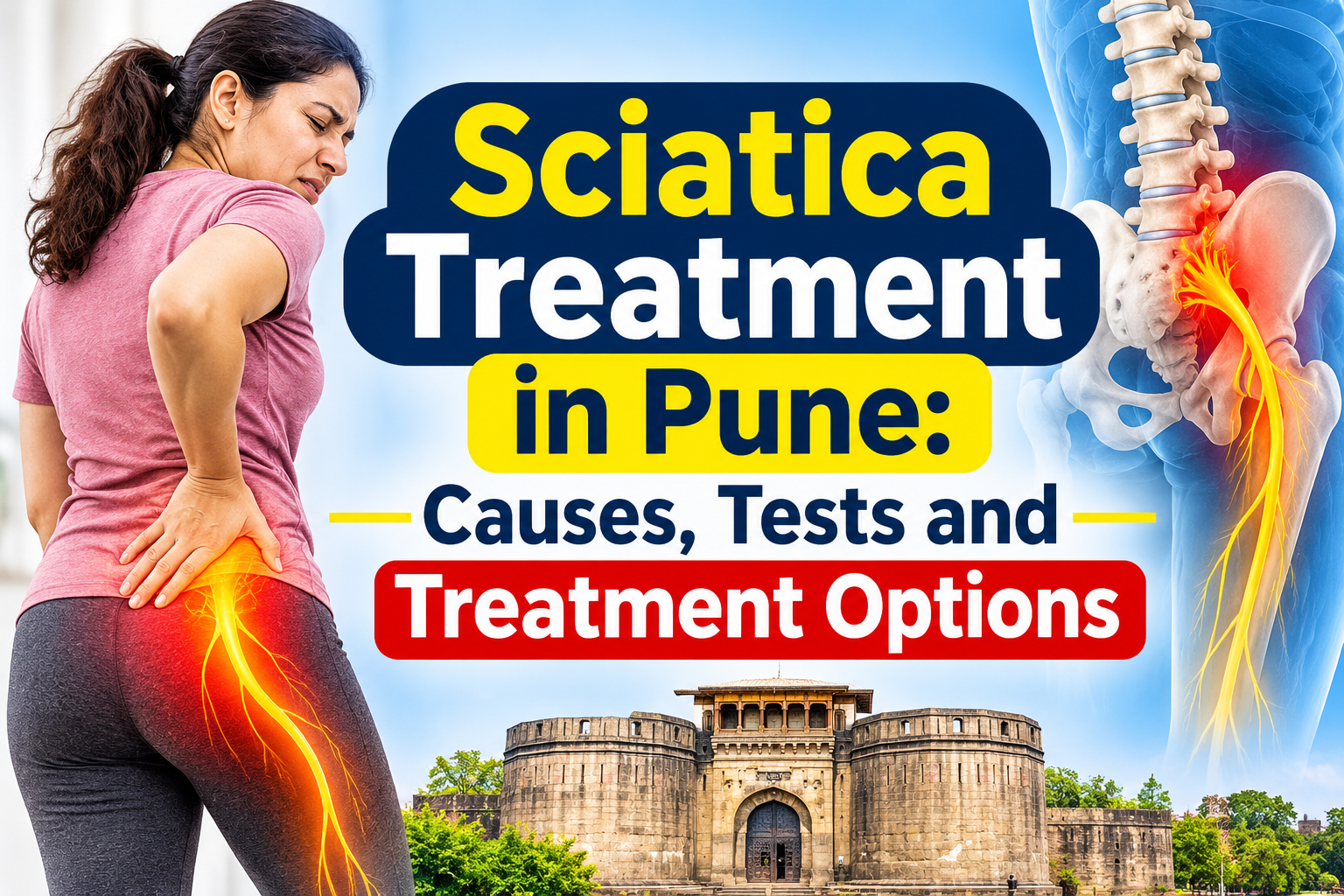
Orthos Centre, Pune | Patient guide | 22 minute read
A sharp, shooting pain that starts in the lower back or buttock and travels down the leg is one of the most common reasons people in Pune visit a spine clinic. If the pain also brings tingling, numbness or a weak foot, you may be dealing with sciatica. The good news is that most people improve with the right non-surgical care, and only a small share need an operation. The harder part is knowing which group you belong to and acting at the right time.
This guide explains sciatica treatment in Pune from start to finish: what sciatica is, the sciatica symptoms to watch for, the causes, the tests that matter (and the ones you may not need yet), every treatment option from home care to surgery, realistic recovery times and what decides the cost. It is written by the team at Orthos Centre, Baner, where Dr. Shrikant Dalal, a sciatica specialist in Pune, treats back and leg nerve pain with both conservative and minimally invasive approaches. If your pain is mostly in the back, our page on back pain treatment in Pune is a good companion read.
What Is Sciatica?
To understand what is sciatica, start with the nerve itself. The sciatic nerve is the longest and thickest nerve in the body. It is formed by nerve roots that leave the lower spine (from L4 to S3), joins in the pelvis, runs deep through the buttock and travels down the back of the thigh, below the knee and into the foot. When one of these roots is pinched or inflamed near the spine, the resulting sciatica nerve pain is felt along the leg, often far from the actual problem. That is why many patients say, “my back is fine, but my leg hurts.”
Doctors also call this lumbar radiculopathy. Sciatica is not a diagnosis by itself. It is a signal that something is irritating the nerve, and the treatment depends on finding out what. It usually affects one leg only. Pain in both legs, or sudden severe weakness, needs a different level of attention, which is covered in the warning signs below.
Sciatica Symptoms: How to Recognise Sciatica Pain
Sciatica symptoms range from a dull ache to an electric, burning pain. The most common signs are:
- Pain that starts in the lower back or buttock and travels down the back or side of the thigh, often below the knee and into the foot.
- Symptoms on one side of the body in most cases.
- A burning, shooting or electric-shock quality to the pain, sometimes with a deep ache in the buttock.
- Tingling, pins and needles or numbness in the leg, foot or toes.
- Weakness in the leg or foot, such as trouble lifting the foot, climbing stairs or standing on your toes.
- Pain that gets worse on sitting, bending forward, coughing, sneezing or straining, and eases on walking or in a particular position.
- Night pain, or sharp pain when getting up from a chair or a two-wheeler seat.
Ordinary back pain stays mostly in the back and rarely goes below the knee. Leg pain that travels below the knee, especially with tingling or numbness, is a stronger hint of sciatica. The place where you feel the pain also helps a specialist work out which nerve root is involved:
| Nerve root | Where you feel it | Weakness or reflex change |
|---|---|---|
| L4 | Front of the thigh and inner side of the shin | Difficulty straightening the knee; reduced knee jerk |
| L5 | Outer side of the leg, top of the foot and big toe | Weak big toe or ankle lift; foot drop |
| S1 | Back of the calf, heel, outer foot and sole | Difficulty standing on toes; reduced ankle jerk |
This table is only a guide. A clinical examination is needed to confirm which nerve is affected.
When Is Sciatica an Emergency?
Most sciatica is painful but not dangerous. A few symptoms, however, can mean serious nerve compression, infection or another condition that should never be left to settle on its own. Seek urgent care if you have:
- Numbness around the groin, genitals or inner thighs (the “saddle” area).
- Difficulty passing urine or stool, loss of control, or not feeling when you pass them.
- Weakness in both legs, or weakness or foot drop that is getting worse quickly.
- Severe pain after a fall or accident, or pain with fever, unexplained weight loss, or a history of cancer, TB or recent infection.
These can point to conditions such as cauda equina syndrome, where delay can cause lasting damage. Do not wait for physiotherapy to work. Orthos Centre offers emergency services at Baner, so call us or go to the nearest emergency department straight away.
Sciatica Causes: What Is Pinching the Nerve?
The main sciatica causes sit in the lower spine, but a few come from the muscles and joints around the pelvis. Different causes produce similar sciatica symptoms, so knowing the cause matters because it decides the treatment.
Slipped (herniated) disc
This is the most common cause, especially between the ages of 30 and 50. The soft cushion between two vertebrae bulges or tears and presses on a nearby nerve root. Disc-related sciatica often starts after lifting, twisting or long hours of sitting, and many discs settle on their own over weeks to months.
Lumbar spinal stenosis
In stenosis, the space around the nerves narrows because of age-related changes in the discs and joints. It is more common after 50. A typical pattern is leg pain, heaviness or numbness that comes on with walking and eases when you sit or bend forward.
Spondylolisthesis
Here one vertebra slips forward over the one below it, narrowing the space for the nerve. It can cause back pain along with leg symptoms, and may need more careful assessment for instability.
Piriformis syndrome and sacroiliac joint problems
Sometimes the nerve is irritated outside the spine, where it passes the tight piriformis muscle in the buttock, or the pain comes from the sacroiliac joint. These mimic sciatica, so the examination matters. Our article on sciatica vs piriformis syndrome explains how to tell them apart.
Less common causes
Spinal infections (including spinal TB), tumours, fractures, cysts and severe injuries can all press on the nerve. Diabetes can also cause nerve pain in the legs that looks like sciatica. These are less common, but they are exactly why a proper examination is better than guessing.
Who Gets Sciatica? Risk Factors in Pune
Sciatica can affect anyone, but certain habits and conditions raise the risk. In a city like Pune, a few are especially common:
- Long hours of sitting: desk jobs in the IT hubs of Baner, Hinjewadi, Kharadi and Hadapsar keep the discs under steady pressure. See our note on neck pain from a desk job for desk habits that also affect the lower back.
- Long two-wheeler commutes: hours on a bike or scooter over uneven roads add vibration and a poor sitting posture.
- Heavy lifting or sudden twisting: at work, at the gym or at home.
- Excess weight: extra weight loads the lower spine. Our healthy weight management service can help.
- Smoking and diabetes: both affect disc health and nerve healing.
- Weak core muscles and a sedentary lifestyle: the spine loses support.
- Age: disc problems peak in the 30s to 50s, and stenosis becomes more common later.
How Is Sciatica Diagnosed? Tests You May Need
A good sciatica doctor in Pune starts by listening and examining you, not by ordering every scan. The aim is to link your sciatica symptoms to a specific cause.
History and physical examination
The doctor will ask where the pain starts, what makes it worse, whether you have numbness or weakness and whether your bladder or bowels are affected. The examination includes the straight leg raise test (lifting the leg while you lie down to see if it reproduces the pain), reflexes, muscle strength, sensation and the way you walk, including on toes and heels.
X-ray
An X-ray shows the alignment of the spine, a slipped vertebra, arthritic changes and the height of the disc spaces. It does not show discs or nerves directly. Standing or bending views can reveal instability.
MRI scan
A sciatica MRI is the best test for seeing discs, nerve roots and the spinal canal. Do you need one right away? Not always. Without warning signs, many people improve in the first four to six weeks with non-surgical care, and an early scan can show harmless disc bulges that do not need treatment. Your sciatica specialist in Pune will advise an MRI when the pain is severe, when there is weakness or numbness, when symptoms last beyond about six weeks, or when an injection or surgery is being considered. The scan must always be matched with your symptoms, because many people with no pain also show disc bulges.
CT scan
A CT scan studies the bones in more detail and is used when an MRI cannot be done, for example in some patients with a pacemaker or certain implants.
Nerve conduction studies and EMG
These tests measure how well the nerves carry signals and are useful when the diagnosis is unclear, when diabetes may be involved or when several levels could be responsible.
Blood tests
Blood tests help when infection, inflammation, diabetes or vitamin deficiencies may be contributing, and are routine before an injection or surgery.
Sciatica Treatment in Pune: Options From Simple Care to Surgery
Treatment follows a ladder. Most patients begin on the first step and move up only if they need to. The table below gives the overview, and each step is explained after it.
| Step | What it involves | Usually suited for |
|---|---|---|
| 1. Self-care and staying active | Walking, posture changes, heat or cold, short-term medicines | Most new episodes |
| 2. Physiotherapy and rehabilitation | Nerve mobilisation, core strengthening, manual therapy, dry needling, electrotherapy | Pain lasting more than a couple of weeks, or repeated episodes |
| 3. Image-guided injection | Epidural steroid or selective nerve root block | Severe leg pain not settling with steps 1 and 2 |
| 4. Surgery | Keyhole or endoscopic discectomy, decompression, fusion in selected cases | Weakness, emergencies, or pain that fails proper non-surgical care |
Step 1: Self-care and staying active
Contrary to old advice, long bed rest does not help sciatica and can slow recovery. Gentle walking several times a day, changing position often and returning to light activity as pain allows is the foundation. Heat or cold packs, a supportive chair and short-term medicines can give early sciatica pain relief and make this easier. Most people with a recent slipped disc and no warning signs start here.
Medicines for sciatica pain relief
For short-term sciatica pain relief, doctors may prescribe anti-inflammatory painkillers, muscle relaxants for a few days, and nerve pain medicines when burning or tingling dominates. A short course of oral steroids is used in some cases. These should be taken only as prescribed, because long self-medication can harm the stomach, kidneys and blood pressure, and some medicines cause drowsiness. Medicines reduce sciatica symptoms so that you can move and exercise. They do not fix the cause on their own.
Physiotherapy and rehabilitation
Sciatica physiotherapy in Pune works best when it is matched to your diagnosis, and it gives longer-lasting sciatica pain relief than medicines alone because it treats the cause, not only the pain. It usually includes nerve mobilisation exercises, core and hip strengthening, posture correction and hands-on techniques to ease muscle spasm. At Orthos Centre, our rehabilitation services include spine rehabilitation, manual therapy, dry needling, electrotherapy and posture training, so your sciatica specialist in Pune can keep your plan under one coordinated team.
Sciatica treatment without surgery
The vast majority of patients are managed with sciatica treatment without surgery: staying active, medicines, physiotherapy and, where needed, an injection. Slipped discs often shrink naturally over weeks to months, and the nerve calms down with them. This approach also suits many patients with chronic pain, where our chronic pain management service can add further options. The key is to review the plan if you are not improving, rather than waiting indefinitely.
Epidural steroid injection and nerve root block
When leg pain is severe and not settling, a sciatica specialist in Pune can place anti-inflammatory medicine close to the irritated nerve root under X-ray guidance. The aim is to give sciatica pain relief by calming the nerve so that you can take part in rehabilitation. The relief varies from person to person and may be temporary. Risks are small but include infection, bleeding and a short rise in blood sugar in people with diabetes, so the decision is made case by case.
Sciatica surgery in Pune: when is it needed?
Sciatica surgery in Pune is considered only in specific situations:
- Severe leg pain that has not improved after roughly six to twelve weeks of proper non-surgical treatment.
- Progressive weakness or foot drop.
- Cauda equina syndrome, which is an emergency.
- Spinal stenosis that limits walking and daily life.
- Instability or slippage that is causing nerve symptoms.
The operation is matched to the cause, and when a disc is pressing on the nerve, it can give quick sciatica pain relief in the leg. A microdiscectomy removes the part of the disc pressing on the nerve. Endoscopic spine surgery and keyhole discectomy do the same through a very small incision with a thin camera, and many patients go home the same day or the next day. Decompression frees the nerve in stenosis, and fusion is used when the spine is unstable. These are performed as minimally invasive spine surgery wherever suitable, using a surgical microscope, spine navigation and intraoperative neuromonitoring, and robotic assistance is available for complex cases through our robotic spine surgery service. If surgery is advised, read our 25 questions to ask before spine surgery in Pune and plan your recovery with our post-operative exercises.
Sciatica Pain Relief at Home: What Helps and What to Avoid
Good sciatica pain relief at home speeds recovery and reduces how often you need medicines. These habits help most patients, but check with your doctor if you have weakness or any warning sign.
What helps
- Keep moving: short, comfortable walks every few hours work better than lying down.
- Heat or cold: use a warm compress or an ice pack for 15 to 20 minutes, whichever eases the pain.
- Sleeping position: lie on your side with a pillow between your knees, or on your back with a pillow under your knees.
- Sitting and driving: use a small cushion behind the lower back, sit with your feet flat and take a short break every 30 to 45 minutes.
- Gradual return to work: avoid a sudden full workload, and alternate sitting and standing if you can.
Sciatica exercises to ask your physiotherapist about
Sciatica exercises should be started only after your doctor or physiotherapist confirms they suit your diagnosis, because a movement that helps one patient can aggravate another. Commonly used ones include:
- Pelvic tilts and gentle core activation to support the lower back.
- Cat-camel movements for spinal mobility.
- Knee-to-chest and gentle piriformis stretches, if comfortable.
- Glute bridges once pain allows.
- Nerve glides, which help the nerve slide freely.
Stop and tell your therapist if the leg pain spreads further down the leg or becomes stronger during an exercise.
What to avoid
- Complete bed rest for days.
- Heavy lifting, toe-touching and full sit-ups during a flare-up.
- Long, uninterrupted sitting, including long two-wheeler rides while pain is active.
- Forceful back or neck manipulation by untrained people, and deep, hard massage over the spine.
- Buying painkiller or steroid injections from a chemist without a prescription.
- Ignoring weakness or numbness because the pain has reduced.
For lasting sciatica pain relief, home care combined with supervised physiotherapy usually works better than medicines alone.
How Long Does Sciatica Last? Sciatica Recovery Time
Many people feel much better within about four to six weeks, and most within three months. Some sciatica symptoms, such as numbness and tingling, may take longer to settle because nerves heal slowly. Disc-related sciatica often improves as the bulge shrinks and the inflammation fades.
Your own sciatica recovery depends on the cause, how severe the compression is, how early you start treatment, your weight and smoking habits and the demands of your job. If severe pain continues beyond about twelve weeks, it is called chronic sciatica and needs a fresh assessment with an MRI, and possibly an injection or surgery. Sciatica can return, which is why prevention matters as much as treatment.
Sciatica in Pregnancy, Older Adults and Both Legs
Sciatica in pregnancy
Sciatica in pregnancy is common because of the growing uterus, changes in posture and hormones that loosen the ligaments. Some sciatica symptoms in pregnancy are actually pelvic girdle pain. Safe steps for sciatica pain relief in pregnancy include prenatal physiotherapy, a support belt, side-lying with a pillow between the knees and a warm compress. Many painkillers are not safe in pregnancy, so take only what your obstetrician approves, and tell her about any leg weakness or numbness.
Sciatica in older adults
In older adults, spinal stenosis is a frequent cause. A sciatica specialist in Pune will take bone quality, other illnesses and fitness into account, and age alone does not rule out surgery when it is needed.
Sciatica in both legs
Sciatica symptoms in both legs, including pain, numbness or weakness, are not typical and need prompt evaluation, as they can come from central stenosis or a large central disc. With bladder or bowel problems, it is an emergency.
Sciatica Treatment Cost in Pune: What Decides the Bill
There is no single price, because sciatica cost depends on what you actually need. The main factors are the consultation, tests such as MRI, medicines, the number of physiotherapy sessions, an injection procedure if needed and, if surgery is advised, the technique, the hospital stay and the anaesthesia. Non-surgical care generally costs much less than surgery, which is another reason to treat early and review regularly.
Ask your sciatica specialist in Pune for a written estimate that lists what is included and what could be extra. If you have health insurance, ask whether the procedure is covered and whether cashless approval is available. Our team can help when you contact Orthos Centre.
Which Doctor to See for Sciatica? Choosing a Sciatica Specialist in Pune
Orthopaedic spine surgeons, neurosurgeons, pain specialists and neurologists all treat sciatica. For most patients, starting with a spine specialist is sensible because the same doctor can plan both non-surgical care and, if needed, surgery. A good sciatica specialist in Pune should:
- Examine you carefully before recommending scans or procedures.
- Explain your diagnosis in simple words and show you the MRI.
- Offer non-surgical care first when it is safe to do so.
- Explain the risks and alternatives clearly if surgery is suggested, and welcome a second opinion.
- Be registered with the medical council and be able to say how often they perform the procedure they advise.
You can read about Dr. Shrikant Dalal on our spine specialist in Pune page, and our 10 questions to ask your spine surgeon before surgery gives a short checklist for your visit.
How to Prevent Sciatica From Coming Back
- Strengthen your core: strong abdominal and back muscles protect the discs. Ask your physiotherapist for a routine you can keep up.
- Set up your desk: keep the monitor at eye level, support your lower back and keep your feet flat on the floor.
- Break up sitting: stand and walk for a minute or two every 30 to 45 minutes.
- Lift smartly: bend your knees, keep the load close and avoid twisting while lifting.
- Manage weight and blood sugar: both reduce the load and help nerve health.
- Do not smoke: smoking weakens the discs and slows healing.
- Ride sensibly: on long two-wheeler trips, stop to stretch, and sit with a neutral spine.
Our posture training programme and the FAQs page on spine care can help you build these habits.
Sciatica Treatment at Orthos Centre, Baner, Pune
At Orthos Centre, every patient begins with a detailed examination by Dr. Shrikant Dalal (MBBS, DNB, Robotic & MIS Spine), followed by only the tests that are needed. Your plan then moves step by step: lifestyle changes and medicines, our in-house rehabilitation services, injections where suitable, and surgery only when it is truly indicated. If you need an operation, we use surgical microscopes, spine navigation and intraoperative neuromonitoring, with keyhole and endoscopic options for suitable cases. Emergency services are available, and you can learn more about the clinic on our About Clinic page, see our timetable or watch our patient education videos, including talks on slip disc and spinal canal stenosis.
If you are looking for sciatica treatment in Pune that explains each option and does not rush you into surgery, we are located in PrimeRose Mall, Baner Road, and open from 9 AM to 10 PM every day.
Sciatica FAQs: Questions Patients in Pune Ask
What is the fastest way to cure sciatica?
There is no instant cure, but the fastest route to recovery and sciatica pain relief is the right diagnosis, staying active, short-term medicines for pain control, targeted physiotherapy and an injection if the pain is severe. Resting in bed for days usually slows things down.
Can sciatica go away on its own?
Yes, many cases improve within weeks to a few months, especially those caused by a slipped disc. But if the pain is severe, keeps returning or comes with weakness or numbness, get it checked instead of waiting.
Is walking good for sciatica?
In most cases, yes. Gentle walking improves blood flow and keeps the spine moving. Walk at a comfortable pace and stop if the leg pain gets worse or you develop weakness. In spinal stenosis, walking itself may bring on symptoms, which is a useful clue for your doctor.
Which doctor should I consult for sciatica in Pune?
For sciatica treatment in Pune, a spine specialist, meaning an orthopaedic spine surgeon or a neurosurgeon, is a good first choice because they can manage both non-surgical and surgical treatment. A sciatica specialist in Pune will usually work with physiotherapists, pain specialists and neurologists as a team.
Do I need an MRI for sciatica?
Not always at the start. An MRI is advised if pain is severe, if you have weakness or numbness, if symptoms last more than about six weeks or if an injection or surgery is being planned. It is needed urgently if you have any warning sign.
Can sciatica cause permanent damage?
Most sciatica does not cause permanent damage. However, prolonged severe nerve compression can lead to lasting weakness or numbness, and cauda equina syndrome can cause permanent bladder, bowel and leg problems if not treated urgently.
Does sciatica always need surgery?
No. Only a small share of patients need an operation, usually for persistent severe pain, progressive weakness or an emergency. Most improve with sciatica treatment without surgery.
Can sciatica be cured permanently?
Many people recover fully and never have another episode, while others have occasional flare-ups. Staying active, strengthening the core, keeping a healthy weight and using good posture lower the chance of recurrence.
What is the right sleeping position for sciatica?
Most people are comfortable lying on the side with a pillow between the knees, or on the back with a pillow under the knees. Choose the position that keeps the spine neutral and the leg pain lowest.
Is sciatica the same as a slipped disc?
No. Sciatica is the symptom of leg pain from nerve irritation, and a slipped disc is one of the most common causes. Stenosis, a slipped vertebra and muscle problems can cause sciatica as well.
Can sciatica cause foot numbness or foot drop?
Yes. Pressure on the L5 or S1 nerve roots can cause numbness in the foot, and L5 involvement can cause foot drop, where you cannot lift the front of the foot. New or worsening weakness should be seen by a spine specialist urgently.
How is sciatica different from piriformis syndrome?
Sciatica from the spine usually comes with back pain and may worsen on bending or coughing, while piriformis syndrome mainly causes buttock pain that worsens with sitting or hip movement. The examination and sometimes an MRI separate the two. Read our detailed guide on sciatica vs piriformis syndrome.
Is yoga good for sciatica?
Gentle, guided stretching can help once the acute pain has settled. In the early phase, avoid deep forward bends and strong twists, and practise only under the guidance of a trained therapist who knows your diagnosis.
Take the First Step Towards Sciatica Relief
Sciatica is painful, but with the right sciatica treatment in Pune it is manageable, and most people get better without surgery. The key is a clear diagnosis, a stepwise plan and prompt action if warning signs appear. If your leg pain, tingling or weakness is not improving, meet our team to get answers. You can also read more on the Orthos Centre blog.
Get your symptoms and MRI reviewed by Dr. Shrikant Dalal and understand every option before you decide.
Book a Consultation Call +91 96191 75354Contact Orthos Centre
Clinic: Orthos Centre, Office No. 9, 1st Floor, PrimeRose Mall, Baner Rd, Balewadi Phata, Pune, Maharashtra 411045
Phone: +91 96191 75354
Email: clinicorthos@gmail.com
Timing: 9 AM to 10 PM, Monday to Sunday
This article is for general education and does not replace personal medical advice. Every patient is different, so please consult a qualified spine specialist before making any treatment decision.
